


This edition of Leverage was produced primarily by a team of AI agents as an experiment. I thought it was OK but decided not to continue the experiment. Going forward, to the degree I get around to writing anything, I’ll write it myself.
A small built-environment consulting practice, Copeland Building Envelope Consulting (CopelandBEC), spent 2026 doing work it could not have done, or not done well, the year before.
More research got finished. More documents actually got reviewed, instead of waiting in the pile. The office produced kinds of deliverables it used to skip, and put information in interactive formats clients could use. It made art and visuals that, for a firm of that size and budget, used to be out of reach. Risk management and finance got sharper. And it built complex custom software that is now the backbone of how the place runs.
That list comes from that one office. It is a sample of one. It is not a survey, and it is not a claim about the industry mean.
Judgement was in the work the whole time. Someone decided what to ask the tools, what to keep, what to throw out, and what to tell the client. If a first pass was any good, a person who knows the work had already steered it, including how that first pass got made. Expertise, creativity, and guidance sat in those choices.
Most of the published numbers still describe a thinner year.
The RIBA Artificial Intelligence Report 2026 is a self-selecting survey of more than 1,100 design professionals, fielded in March and April. Practices reporting any AI use on current projects rose from 41 percent in 2024 to 74 percent this year. Only 15 percent of those surveyed say the tools are embedded in day-to-day work. Among users, the common jobs are the obvious ones: early-stage visualization, compliance checking, practice management, specification writing. Ten percent or fewer use AI for BIM, performance simulation, or environmental modeling. Seventy-three percent of users report a productivity gain. Seventeen percent say their designs are better because of AI. Seven percent of users say they have raised project fees; 58 percent say they have not.
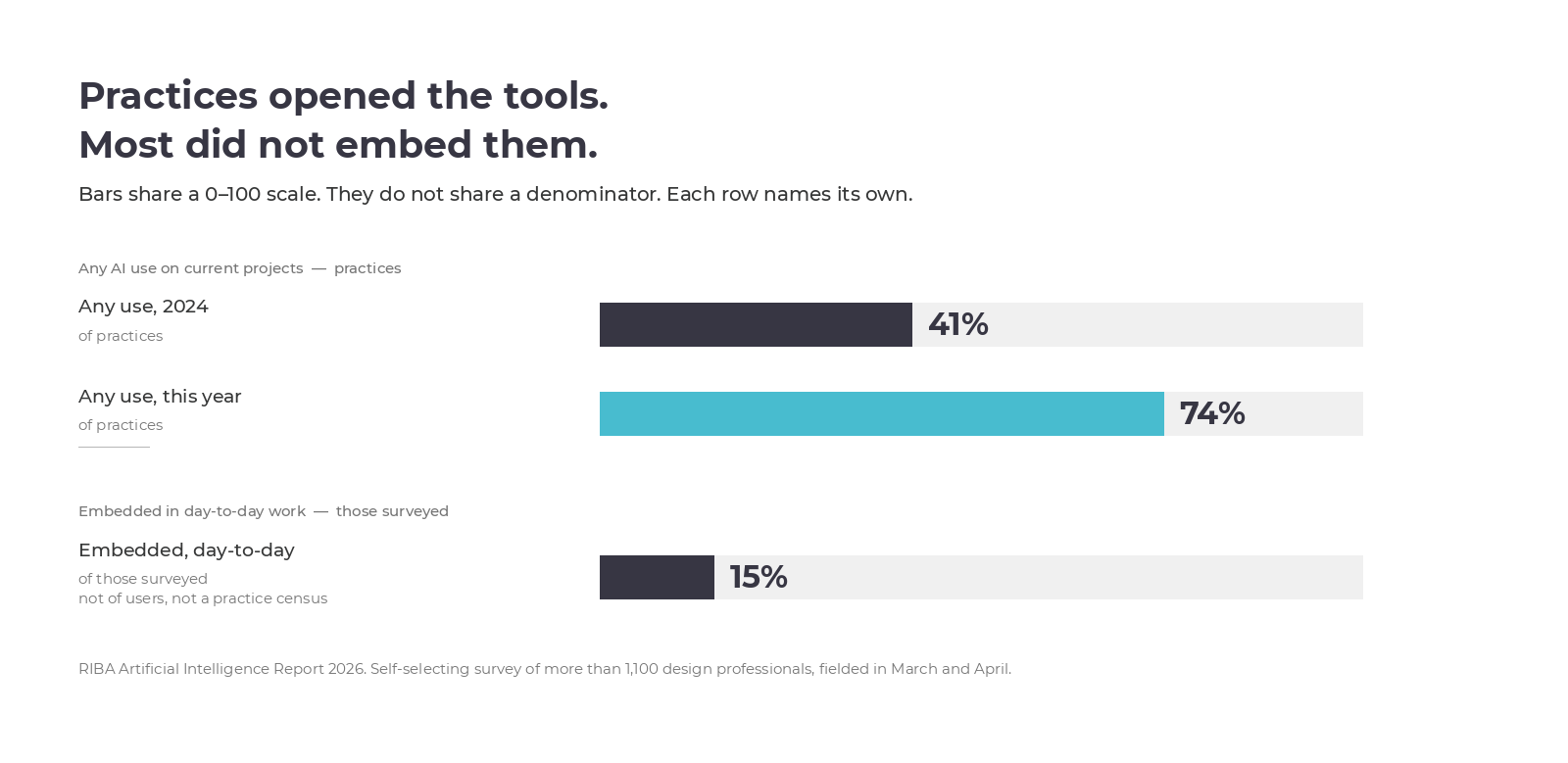
A lot of offices opened the tools. A lot of them are still poking at first-pass pictures and documents. The small practice above is doing something else: more work, better work, and new kinds of work, including software the firm would not have been able to stand up before.
US engineering firms, asked from the executive floor, sound closer to the RIBA mean than to that office. The ACEC Research Institute’s Q1 2026 sentiment survey found more firms writing AI strategies than in prior years, and more than half investing in dedicated AI talent. They are still hiring. The AIA’s last comparable US architecture study, fielded in June-July 2024 and published in March 2025, found that 6 percent of architects used AI regularly. No 2026 AIA update has been published.
Construction is further back. DEWALT’s AI in the Trades study asked people already familiar with AI in construction. Even in that group, 9 percent said they use it in day-to-day work globally, and 8 percent in the US sample. McKinsey’s July paper, How AI is reshaping the future of the AEC industry, is a forecast of what could be automated, not a count of what is: 50 percent of nonphysical architecture-and-engineering work, 39 percent of nonphysical construction work. Construction Dive’s recap of that paper puts autonomous jobsite equipment more than four years out, and names bid/no-bid, estimating, and proposal drafting as the near-term work. Desk work, again.
None of that argues with the small practice. It just says most places are not there yet.
Leverage wrote in March about the gap between what language models could theoretically speed up and what offices were actually using. Massenkoff and McCrory still do not print an architecture-and-engineering pair for that gap, and secondary readings of their chart still disagree, so this piece will not invent one. A lot of work looks exposed on paper. A lot of offices have barely started. The practice in this piece has.
The jobs did not vanish while that was happening. BLS table A-30 (updated August 7) puts architecture-and-engineering unemployment at 2.1 percent in July 2026, against 2.0 percent a year earlier, both not seasonally adjusted, and both well under the 4.4 percent rate for the whole labor force, also not seasonally adjusted. Massenkoff and McCrory found no systematic rise in unemployment in the most-exposed occupations since late 2022.
Licensing boards have not handed the work to a model either. In January the Interorganizational Council on Regulation said a licensed professional still has to take legal responsibility for technical submissions, and that oversight cannot be automated. NCARB said the same in April. That was never the interesting part. The interesting part is what a professional does with the extra capacity: more research, more review, a visual a small firm could not have bought, a tool the office now runs on.
People are scared about what might happen. The evidence that it has already happened is thin.
Fifty-nine percent of all RIBA respondents expect staff reductions across the profession. Sixty-one percent think early-career people will have a harder time learning the job. Nine percent of practices say AI has already led to staff reductions, barely above 2024, and the source does not show clear evidence of sector-wide cuts. Massenkoff and McCrory did find a tentative drop in the job-finding rate for workers aged 22 to 25 entering the most-exposed occupations. They called it just barely statistically significant, and open to other explanations.
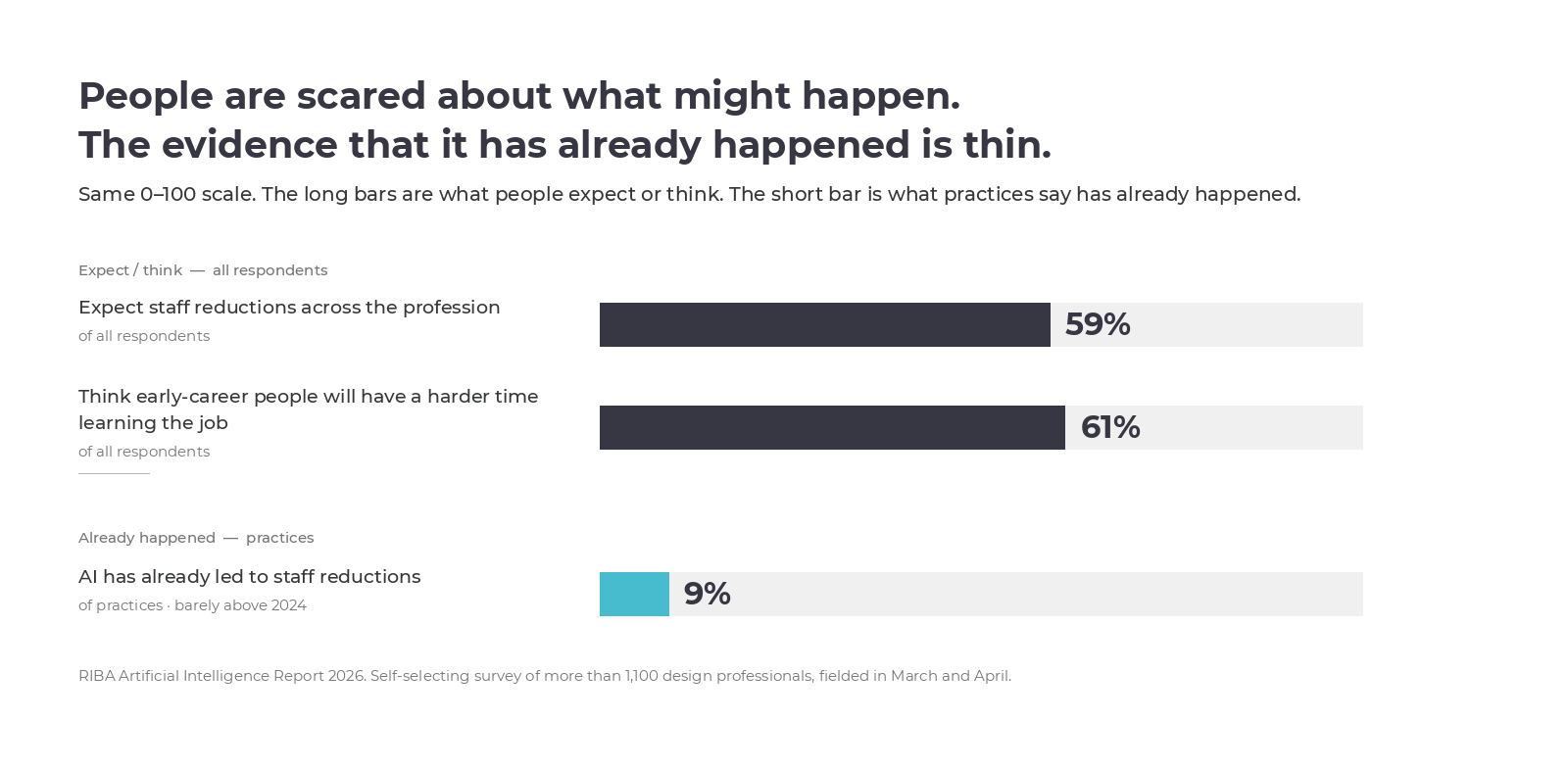
The other picture, from this office, is abundance. The work got larger. Judgement still decides what is good.
An office that only uses the tools to knock out the tasks that used to teach people can look busier and get thinner. An office that uses them the way this one did makes the work itself larger, and the people still have to decide what is good. Those are two different 2026s.
A lot of firms can say they use AI now. What did you make this year that you could not have made last year, and who decided it was any good?