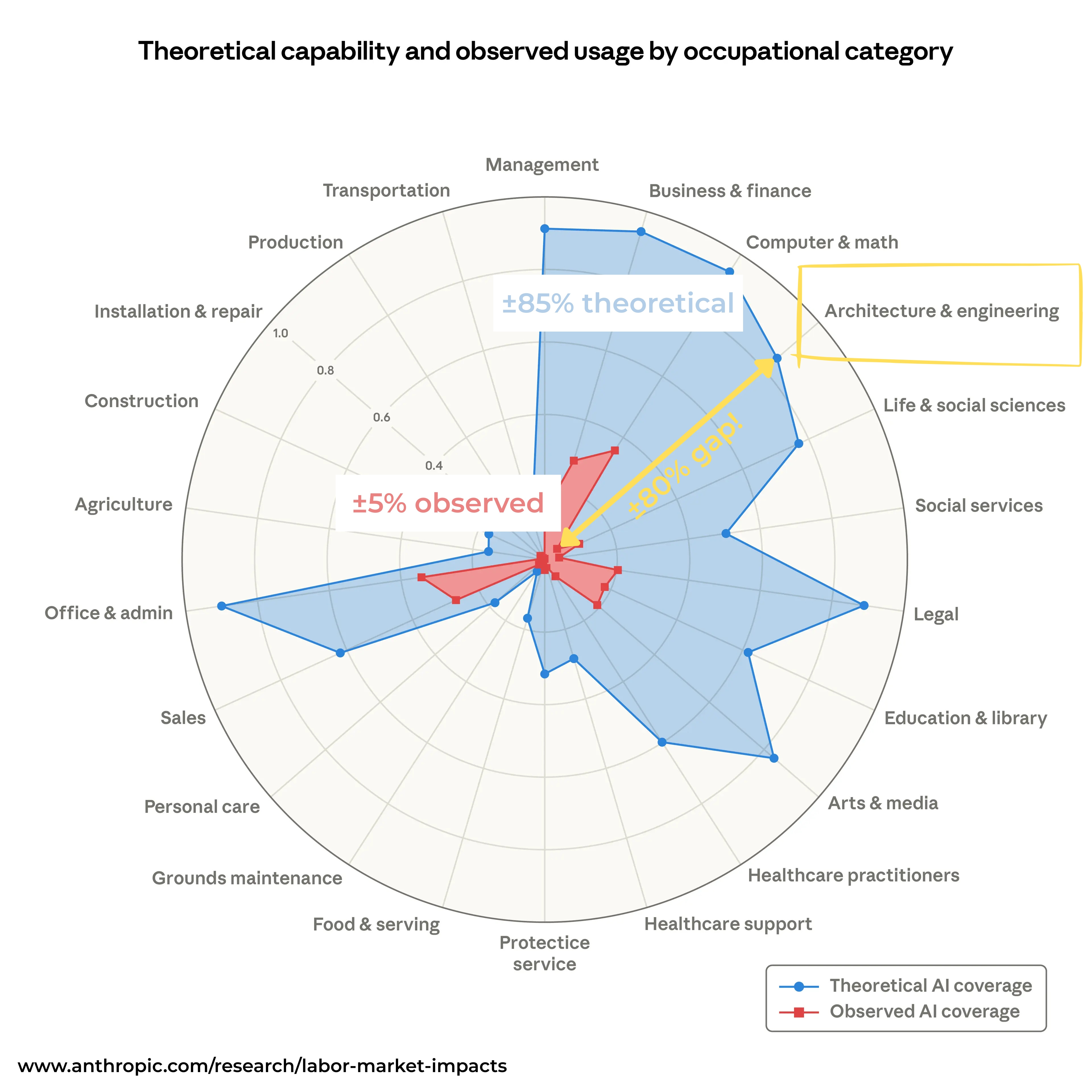
Up to 85% of architecture and engineering is theoretically “exposed” to being automated by AI.
Does that sounds scary? Let me explain why I see opportunity instead.
First, a little background.
Back in 2023, a study by Eloundou et al. evaluated the potential impact of large language models (the foundation of tools like Claude and ChatGPT) on the labor market. Just last week, Anthropic (makers of Claude) released a paper that takes it a step further: they aggregate task-level exposure scores from the Eloundou paper and compare the theoretical exposure of various fields to the actual observed application of AI tools in those fields so far.
Guess which field has the biggest gap between theoretical and actual usage.
Yep, it’s architecture and engineering.
With 85% of A&E tasks theoretically well-suited to having AI leverage applied, practitioners are applying that leverage to only 5% of tasks! A&E is certainly well known for its glacial pace and resistance to change, so no real surprise here.
Here’s where the opportunity part becomes clear, though.
Keep in mind that AEC overall is a two trillion (with a T) dollar industry. A&E services are something like $350B of that.
If 85% of the current work (and $350B of value generated) in those firms can be meaningfully accelerated with AI, then a relatively small number of firms leveraging these tools effectively could serve a wildly disproportionate share of the market.
They will do more business while also delivering better client experiences.
The benefits that accrue to those AI-proficient individuals and firms will compound quickly.
That’s the opportunity.
So what does this actually look like in practice?
Fair question. Here’s a real example from this past week.
Contract review is one of those tasks that I have to do but really don’t like. Reviewing non-standard client contracts, comparing them against the firm’s standards, flagging the problematic clauses, and producing redlines does not spark joy.
Last week, I used Claude to build a custom contract review “skill” for our firm. I fed it our existing contract review standards—the actual criteria we use to evaluate non-standard agreements. Claude built and tested a working prototype independently, then came to me with a draft for feedback. After a couple of iterations, it now produces specific, actionable contract reviews—complete with proposed redlines in a Word document with tracked changes—all consistent with our existing standards.
The whole thing takes a minute or two.
Obviously I still review the output. My judgment is the 15%. But the 85%—reading every clause, cross-referencing against our standards, formatting the redlines—that’s exactly the kind of work that AI handles well. It’s exactly the kind of work I aim to delegate.
That happened last week, and it’s an example of something that is only just now possible. We had previously used a Gemini Gem to help with this and it was OK but not nearly as capable.
Actually using these tools on an ongoing basis is essential to maintaining fluency and realizing the benefits that are available.
Now multiply that across every tedious, time-consuming task in your business. RFIs. Submittal reviews. Window and door schedules. Meeting minutes. Spec cross-referencing. Drawing coordination checklists.
You got into architecture because you love design, but now you spend your days in email and meeting purgatory? Good news—you can start getting back to the work that actually matters.
Are your clients frustrated by slow responses, high fees, and impenetrable documentation? You can leverage these tools to create a client experience that sparks delight, not derision.
That is the opportunity. Delegate and elevate, as the EOS folks say.
If you want to join the 5% who are actually seizing this opportunity, here’s my challenge to you for this week:
Keep a sticky note on your desk.
Every time you do a task that feels like soul-crushing data entry or administrative drudgery (e.g., summarizing meeting minutes, reformatting a schedule, drafting an RFI response), simply write it down.
At the end of the week, pick just one of those tasks.
Open Claude or ChatGPT and type this: “I have to do [one annoying task from your list] for my job. This is how I usually do it: [word vomit a description]. The outcome of all of that work is usually [describe deliverable or end result]. Can you help make that process easier? The specific thing I need to accomplish is [describe deliverable or end result again]—please suggest some ways you could help me to achieve that end result.”
Try what it says, evaluate the results, and give your feedback directly to Claude/ChatGPT. This is how you iterate and improve.
Don’t try to overhaul your entire practice. Just experiment with one tedious task and see what happens. You will be shocked at how quickly you can chip away at that 85%.
—Matt
P.S. This is, no doubt, an over-simplification to make a point. Go read the papers for the nitty gritty on the methodologies and what “exposed to AI” really means. Feel free to hand-wave this analysis away as sensational by nit-picking the details. But if you do, I think you’re missing the forest for the trees. And the forest is brimming with opportunity for those paying attention.